
Code agents such as Claude Code, GitHub Copilot, and Gemini generate code from natural language. This is a major leap that works, until it stops working. Better approaches exist.
The history of software engineering is the history of raising levels of abstraction. — Grady Booch, co-creator of UML
Booch said this decades ago, but the statement has never been more relevant than it is now. Every time the industry has moved up one rung on the abstraction ladder, productivity has increased nonlinearly. Not by 20 percent or 30 percent, but by an order of magnitude.
The relevant question today is not whether AI can generate code. It is which rungs of the ladder it is operating on.
The abstraction ladder, layer by layer
To understand what makes Structura different, it is necessary to understand the conceptual architecture on which all software development operates. Five layers, each closer to human thought and farther from hardware.
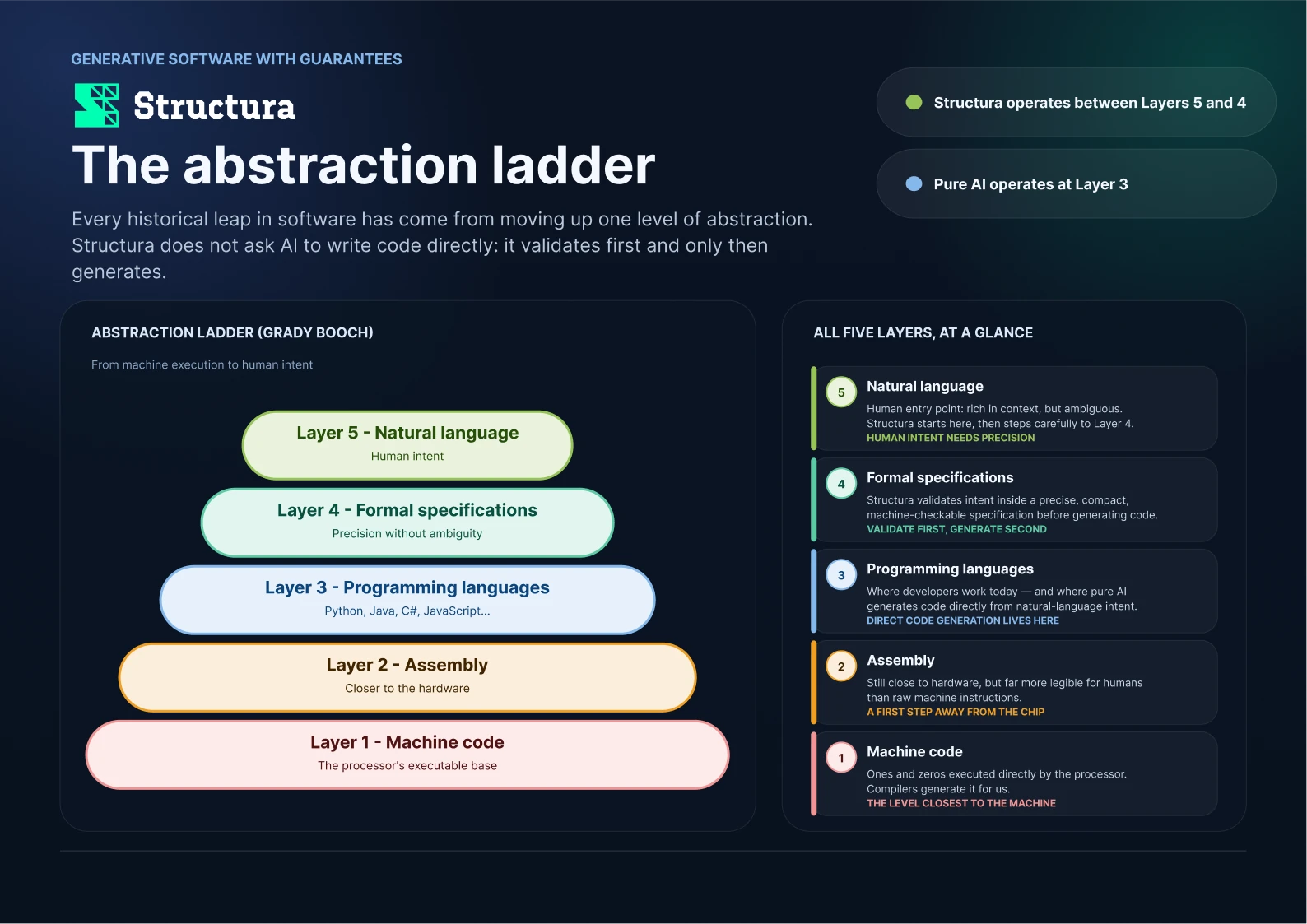
Fig. 1 The abstraction ladder: from machine code to natural language.
Layer 1 — Machine code: the foundation
Instructions encoded in binary and executed directly by the processor. Nobody programs here today. Compilers generate this level automatically, and that problem was solved decades ago. It is worth mentioning only to establish the starting point of the ladder.
This level is too close to the machine for humans to operate efficiently, which is why humans invented the compiler.
Layer 2 — Assembly: the first leap
The first meaningful abstraction in the history of software development: representing machine instructions with mnemonics that humans can read. MOV, ADD, JMP. It was revolutionary at the time. Today it is invisible: compilers handle it without requiring developers to operate at this level.
This leap was the first instance of a pattern that would repeat for decades: moving up one rung of abstraction frees the programmer from low-level detail, multiplies productivity, and makes projects possible that were previously infeasible.
Layer 3 — Third-generation languages: where we live today
Python. Java. C#. Go. Rust. This is the layer where modern software development happens. It is also, with important caveats, the target layer for today’s AI.
Claude Code, GitHub Copilot, Gemini Code, Codex: all of these tools share the same fundamental characteristic. Their output is source code at Layer 3. They take instructions in natural language (Layer 5) and generate source files (Layer 3). That is a jump of two full rungs.
This jump works for small and medium-sized problems. Outside those limits, it runs into structural constraints.
The structural problem with AI at Layer 3 is not model quality. It is the nature of the jump itself: moving from ambiguous language to precise instructions without an intermediate formalization layer.
In small projects, the jump is manageable. The context fits in the model window, coherence across files is still feasible, and the developer can review the output with sound judgment. In enterprise projects, however—dozens of modules, hundreds of classes, distributed teams, compliance requirements—the problems created by a two-rung jump become critical:
- Structural hallucinations. The AI generates code that appears correct but introduces nonexistent dependencies, violates domain invariants, or implements incorrect semantics. At the file level, this can go unnoticed. At the system level, detection and correction are expensive.
- Nondeterminism. The same prompt, at different times or with different context, can produce different architectures. In a team of ten engineers using AI at Layer 3, architectural coherence remains a human responsibility, not a property of the tooling.
- Lack of formal guarantees. There is no mechanism that ensures the generated code satisfies the specification. Validation is manual, expensive, and never exhaustive.
- Linear scaling of the problem. The cost in tokens, time, and review effort grows in proportion to project size. There are no economies of scale: a project ten times larger costs roughly ten times more in AI generation.
Layer 4 — Formal specifications: the rung that changes the rules
Formal specifications are precise, unambiguous, and verifiable descriptions of what a system must do. They are not directly executable code. They are semantic, declarative definitions of expected behavior—the what, not the how—expressed in a precise language that machines can process and verify.
This rung has existed since the 1970s in academia—Z notation, Alloy, TLA+—but it never found its way into industrial software development at scale for a simple reason: writing formal specifications manually required more effort than writing the code directly.
Structura changes that equation for the first time.
Instead of asking AI to generate code directly from natural language, Structura performs two distinct and well-defined operations:
- Semantic translation. User intent expressed in natural language (Layer 5) is converted into a compact, unambiguous formal specification (Layer 4). AI operates only in this step. The resulting specification is small, precise, unambiguous, and verifiable.
- Deterministic compilation. From the formal specification, Structura generates source code in a completely deterministic way. No AI. No token usage. No interpretation. Like a compiler following strict algebraic rules.
The formal specification is orders of magnitude more compact than the code it generates. For an enterprise-scale project, the full specification occupies only a tiny fraction of the resulting codebase. That has direct implications for the cost of AI used in the process, which we will revisit later.
Layer 5 — Natural language: the entry point
Human language. Ambiguous by nature, rich in implicit context, impossible to interpret without general intelligence. It is the entry point for any modern development process, whether based on pure AI or on Structura: requirements.
The difference lies in what happens after Layer 5. Pure AI jumps directly to Layer 3. Structura first steps down carefully to Layer 4, formalizes, removes ambiguity, and only then compiles to Layer 3.
One additional rung changes everything.
Where Structura operates, and why it matters
Structura operates primarily at the interface between Layer 5 and Layer 4. Its value proposition is not that it generates better code than pure AI. It is that it does not need to generate code in the same way.
The correct mental model is not a more advanced AI that writes code faster. It is a compiler that accepts high-level specifications instead of source code. The analogy is precise: just as a C++ compiler is not simply a more sophisticated assembler—it is a qualitatively different abstraction—Structura is not simply a more capable Copilot. It is a different layer.
Pure AI is a very fast builder working from your verbal description. Structura is the architect who first draws the formal plans and then builds from them. The speed of the builder matters less when you already have the plans.
The precise role of AI in Structura
In Structura, AI has a bounded and clearly defined role: translating natural-language intent into formal specifications at Layer 4. Only that step.
That bounded role has three important consequences for enterprise teams:
- Control over AI input. The prompt processed by AI in Structura is the business description, not the implementation. The team keeps semantic control over what the AI is interpreting.
- Verifiable output. The generated formal specification can be reviewed, validated, and audited by the architecture team before a single line of code is generated. There is no code to review yet. There is a specification to approve.
- Full traceability. There is an explicit chain from the natural-language requirement to the formal specification to the generated code. Traceability between requirement and implementation stops being a manual documentation exercise and becomes a structural property of the process.
Code generation as compilation
The step from Layer 4 to Layer 3 in Structura deliberately does not involve AI. It is a deterministic, algebraically verifiable process, equivalent in nature to what a compiler does when it transforms source code into machine code.
This has technical implications that enterprise software architects value especially highly:
- Reproducibility. The same specification always generates the same code. In any environment. At any time. Builds are reproducible by construction, not by team discipline.
- Predictable architecture. The generated code follows defined and known architectural patterns. There are no implicit design decisions taken by the model during generation. The team can reason about the system architecture without reading every generated file.
- Structural testability. Code generated from a formal specification can be tested against that specification. There is no need to infer expected behavior from the code because that behavior is explicit at Layer 4.
- Compliance by design. Certain quality standards and best practices can be enforced by construction during code generation. And that can be demonstrated, reducing the risk of penalties for noncompliance with internal or external policies.
Concrete benefits for enterprise teams
No hallucinations in the code
Hallucinations in pure AI are not a bug in the model. They are an inevitable consequence of asking a language model to interpret domain semantics and translate them into machine instructions in a single step. The model cannot know with certainty whether it has correctly understood the business invariant it has just implemented.
In Structura, AI works only on the specification. The code is not generated by AI. It is generated by the specification compiler. A compiler cannot hallucinate because it does not interpret; it transforms according to algebraic rules. The absence of hallucinations in generated code is not an aspirational quality target for the model. It is a deliberately engineered property of the process.
Guarantees by construction
In pure AI development, the relationship between requirement and code is an implicit promise. The code appears to implement what was requested. It may do so. It probably does. But there is no formal guarantee.
Structura inverts that relationship. The formal specification describes exactly what the system must do. The generated code satisfies that specification by construction: if the specification says that the risk calculation method returns a value bounded between two limits, the generated code has that property. Not as the result of a code review. As the result of the generation process itself.
For environments with compliance, audit, or certification requirements, this is not a minor technical detail. It is the difference between being able to demonstrate that the system satisfies its requirements and having to infer it after the fact.
Economies of scale in AI usage
One of the least obvious but most important aspects of Structura’s model is the economic impact of operating at Layer 4 instead of Layer 3.
In pure AI, token cost grows in proportion to the amount of code generated. A system with hundreds of classes and thousands of methods requires large volumes of code to be generated, and often regenerated. A change in a single requirement may force the regeneration of entire modules.
In Structura, AI processes only the formal specification, which is structurally compact. The relationship between the size of the specification and the size of the generated code is significantly asymmetric: the specification is much smaller than the code it produces.
The direct consequence is that AI cost in Structura does not grow linearly with project size. It grows with specification complexity, which is orders of magnitude more compact than the resulting code.
For enterprise teams managing large-scale systems, that difference in the cost curve is significant. It is not a marginal reduction. It is a change in the nature of the curve.
Speed to the first functional prototype
The conciseness of the formal specification has another important side effect: time to the first functional prototype drops dramatically.
In traditional development, the first prototype arrives only when enough code exists to execute the system’s main flows. That usually requires weeks or months of development. With pure AI at Layer 3, that time decreases significantly, but it still scales with the volume of code to generate.
With Structura, the functional prototype is generated from the specification in the same cycle in which the specification is validated. Time to an executable system is not proportional to the size of the code. It is proportional to the time required to formalize the requirements.
For product validation cycles involving business stakeholders, that reduction in time-to-first-prototype changes the dynamics of iteration. Teams can validate system behavior before committing weeks of engineering effort.
Reduced team size
A less discussed but highly relevant effect for enterprise capacity planning is the reduction in the number of people required for a project of a given size.
When code is generated deterministically from formal specifications, most of the work of translating requirements into code disappears as a manual task. What remains is specification work, validation of the specification, and work on the modules where the formal specification does not cover enough implementation detail—roughly 20 percent of the effort, according to the Pareto approach that Structura explicitly applies to its process.
The rest—roughly 80 percent—is generated. This does not eliminate engineers. It redirects them toward higher-level work, closer to design and specification than to the coding that can now be automated in this way.
When Structura makes sense in an enterprise context
Structura is not the right answer for every context. There are scenarios where pure AI at Layer 3 is the right tool, and others where traditional development remains the only valid option.
Structura is a strong fit when
- The project has scale and structure. A system with dozens of domain entities, multiple layers, and integration requirements is exactly the kind of context where formal specification creates the most value. The larger the system, the more economically valuable a concise specification becomes.
- Compliance and traceability are requirements. Financial services, healthcare, critical infrastructure, or any environment where proving conformity with requirements is itself a business requirement.
- Architecture is an asset that must be preserved. Long-lived systems where maintainability and architectural coherence over time justify the investment in formalization.
- Prototype speed is a business constraint. When validation speed with stakeholders is a competitive factor and reducing time-to-first-prototype has direct product impact.
Pure AI at Layer 3 is still appropriate when
- The project is exploratory. When the goal is to test a new pattern, an emerging technology, or an architecture that is not yet stable, the flexibility of pure AI may be more valuable than formal guarantees.
- Experimentation speed matters more than guarantees. Disposable prototypes, proofs of concept, and technical spikes where the code is not going directly into production.
- The team cannot absorb the formal specification learning curve. Structura requires the team to formalize requirements precisely. If that capability is not developed yet, the investment in the learning curve may not pay off in the short term.
The next rung
Every historical transition on the abstraction ladder has followed the same pattern. First, the new layer appears unnecessarily complex compared to the one below it. Then, a minority of early adopters discover that it solves problems the previous layer could not solve structurally. Finally, the new layer becomes the standard, and the previous one becomes something nobody touches directly anymore.
The transition from machine code to assembly took years. The transition from assembly to high-level languages took years too. The adoption of formal specifications as the operational layer of development will not be different. What makes this moment different is that we now have AI capable of doing the formalization work—the historical bottleneck—in an accessible way.
The question for enterprise teams is not whether this leap will happen. The question is when their systems will be on the right side of the transition.